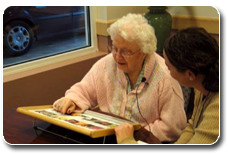

Please note: You have reached the home page of the AAC-RERC, which was funded by NIDRR from 2008-2013.
The home page for the RERC on AAC
(funded by NIDILRR, 2014-2019)
is available at https://rerc-aac.psu.edu
 |
State of the Science Conference in AAC: AAC-RERC Final Report |
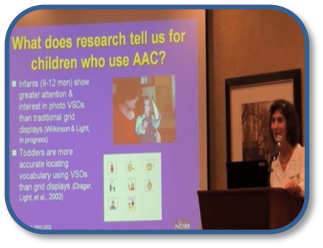 |
State of the Science Conference in AAC: Presentations |
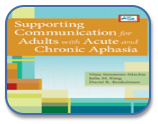 |
Supporting Communication for Adults with Acute and Chronic Aphasia |
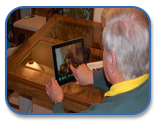 |
Mobile Technologies as Communication Supports for Persons with Primary Progressive Aphasia |
 |
RESNA Student Design Competition |
 |
Tobii T60 and Visual Fixation Patterns of Adults with Aphasia |
 |
The Changing Face of Augmentative and Alternative Communication: Past, Present, and Future Challenges |
 |
Adapted Computer Access |
 |
Daring to Dream |
 |
Implementing Directives that Involve Prepositions with Children with Autism |
|
 |
Brain Computer Interface |
|
|
AAC and Aphasia |
 |
ISAAC 2012 AAC-RERC partners presented at ISAAC 2012 in Pittsburgh, July 30 - August 2. Check this page for conference presentation handouts. |
 |
Update on AAC-RERC State of the Science Report |
|
|
Join us on Facebook |
|
|
We have put copies of some of our most popular webcasts on our YouTube channel, including Disaster Preparedness for People with CCN, AAC for Persons with Primary Progressive Aphasia, and Supporting Communication for People with Minimal Movement. |
|
|
E-Learning Resources |
|
|
Webcasts and Certificates of Completion |
|
|
eBlast The E-Blast service from the AAC-RERC (2008-2013) is no longer available. To subscribe to the eBlast from the RERC on AAC ( 2014-2019) please go to https://rerc-aac.psu.edu/dissemination/eblast/ |
|
|
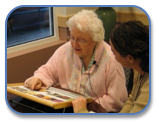


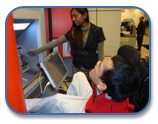

The AAC-RERC (2008-2013) was a Rehabilitation Engineering Research Center that functioned as a collaborative research group dedicated to the development of effective AAC technology. Augmentative and alternative communication (AAC) refers to ways (other than speech) that are used to send a message from one person to another.
Recent Presentations and Publications
Beukelman, D., Fager, S., King, J., & Hux, K. (November, 2012). AAC for adults with Acquired Neurological Conditions: Today & tomorrow. Presentation at ASHA, Atlanta, GA (handout),
Cook, A., McNaughton, D., Powell, J. (June, 2013). Peer Review Journals: Behind the Scenes. Presentation at RESNA. Bellevue, Washington.
DeRuyter, F. (February, 2013). Emerging developments in augmentative and alternative communication. Presentation at CSUN, CA. (handout)
Fager, S., Jakobs, T., Beukelman, D., Ternus, T., & Schley, H. (2012). New AAC Access Strategy for Gesture Tracking: A Technical Note. Perspectives on Augmentative and Alternative Communication, 21(1), 11-16. (abstract)
Fried-Oken, M. (January, 2013). Report on the 2012 AAC-RERC State of the Science Conference. Presentation at the ATIA/RESNA Research Symposium, Orlando, FL. (handout)
Fried-Oken, M., Rowland, C., Daniels, C., Mooney, A., & Noether, G. (January, 2013). Mobile Technologies as Communication Supports for Persons with Primary Progressive Aphasia Presentation at the ATIA/RESNA Research Symposium, Orlando, FL. (handout)
Fried-Oken et al., (June, 2013). The Rsvp Keyboard™: A Brain-Computer Interface For Communication By People With Locked-In Syndrome. Presentation at RESNA, Bellevue, WA.
Higginbotham, D. J., & Engelke, C. R. (2013). A primer for doing talk-in-interaction research in augmentative and alternative communication. Augmentative and Alternative Communication, 29, 3-19. (abstract)
Light, J. (November, 2012). Building communicative competence with individuals who require AAC. Presentation at ASHA, Atlanta GA (handout)
Light, J., Drager, K., & Currall, J. (November, 2012). Effects of AAC technologies with "Just in Time" programming. Presentation at ASHA, Atlanta GA.(handout)
Light, J., Drager, K. Currall, J. & Roberts, B. (November, 2012). Preservice training of speech-language pathologists in evidence-based AAC services. Presentation at ASHA, Atlanta, GA (handout)
Light, J., Drager, K., Wikinson, K., Finke, E., Currall, J., Roberts, B. (November, 2012). The Penn State AAC Leadership Project: Doctoral Training in AAC. Presentation at ASHA, Atlanta, GA (handout)
Light, J., & McNaughton, D. (2012). The changing face of augmentative and alternative communication: Past, present, and future challenges. Augmentative and Alternative Communication, 28, 197-204. (full text available on request by email to aac.journal@gmail.com)
McNaughton, D. (June, 2013). Online approaches to prepare professionals to support assistive technology. Panel presentation at RESNA. Bellevue, Washington
McNaughton, D., & Light, J. (2013). The iPad and mobile technology revolution: Benefits and challenges for individuals who require augmentative and alternative communication. Augmentative and Alternative Communication, 29, 107-116. (full text available on request by email to aac.journal@gmail.com)
McNaughton, D., & Chapple, D. (2013). AAC and Communication in the Workplace. Perspectives on Augmentative and Alternative Communication, 22(1), 30-36. (abstract)
Min, H., Higginbotham, D. J., Lesher, G., & T.F. Yik, (November, 2012). Exploring the contribution of conversational context in word prediction. Presentation at ASHA, Atlanta, GA (handout 1, handout 2)
Schlosser, R. W., Laubscher, E., Sorce, J., Koul, R., Flynn, S., Hotz, L., ... & Shane, H. (2013). Implementing directives that involve prepositions with children with autism: A comparison of spoken cues with two types of augmented input. Augmentative and Alternative Communication, 29, 132-145. (abstract)
Thiessen, A., & Beukelman, D. (2013). Training Communication Partners of Adults Who Rely on AAC: Co-Construction of Meaning. Perspectives on Augmentative and Alternative Communication, 22, 16-20. (abstract)
Wallace, S., & Hux, K. (2013). Effect of two layouts on high technology AAC navigation and content location by people with aphasia. Disability and Rehabilitation Assistive Technology, Early Online: 1-10. (abstract)
Williams, M., Beukelman, D., & Ullman, C. (2012). AAC Text Messaging. Perspectives on Augmentative and Alternative Communication, 21(2), 56-59. (abstract)
 |
Content for this website was developed and maintained by David McNaughton (Penn State University) |
